Standardization, AI, visual evidence: rethinking hair assessment with the C-Cube
Hair assessment protocols have become considerably more refined in recent years. With increasingly targeted treatments (anti-hair loss, strengthening, soothing, anti-dandruff), expectations in terms of evidence have become more specific.
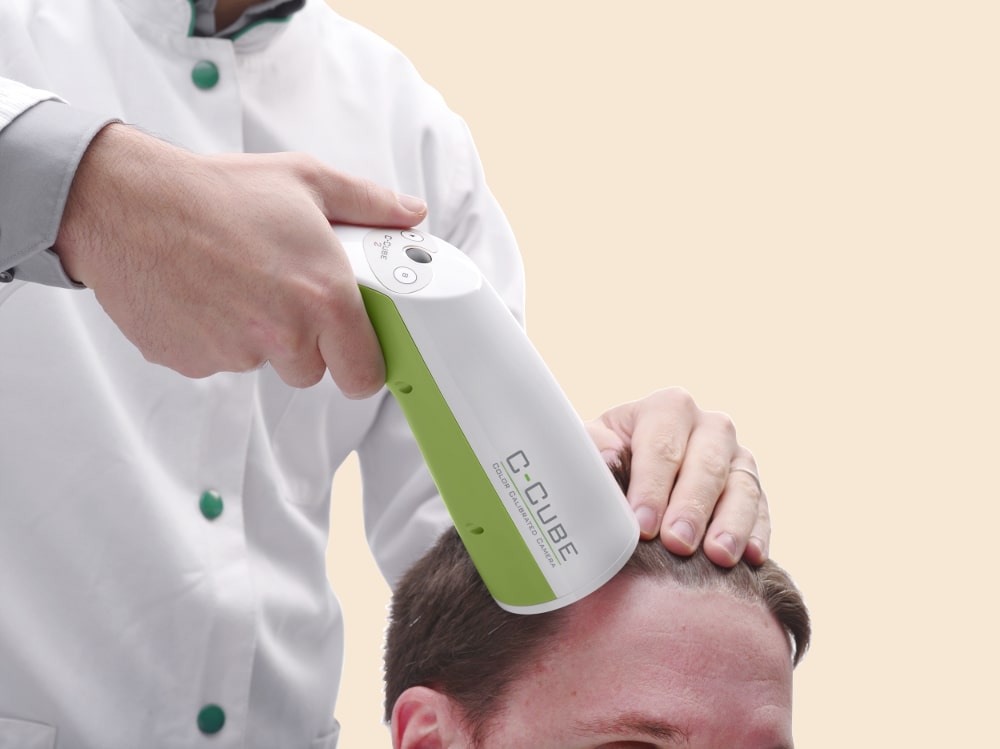
Faced with these challenges, clinical imaging is evolving. C-Cube Clinical Research embodies this new generation of tools designed to combine scientific rigor and field efficiency in hair and scalp studies.
Standardize for better comparison
The C-Cube is based on ultra-high-resolution optics, patented homogeneous LED lighting, and, above all, metric and colorimetric calibration. With each shot, these elements ensure perfectly reproducible images, regardless of the operator, environment, or study time. This rigorous standardization not only allows for objective comparison of parameter changes, but also establishes a reliable basis for automated analysis without time-consuming manual reprocessing.
A solution designed for clinical studies
The C-Cube format is designed for the field:
Compact, it fits easily into your laboratories.
Easy to use, it does not require extensive training.
Accurate, it ensures fully reliable results.
Versatile, a single tool for 2D, 3D, capillary, and ex vivo measurements.
C-Cube Clinical Research provides reproducible data on the most frequently studied hair parameters. Here is an overview of the main indicators that C-Cube can extract, and the claims they can help validate.
Hair density
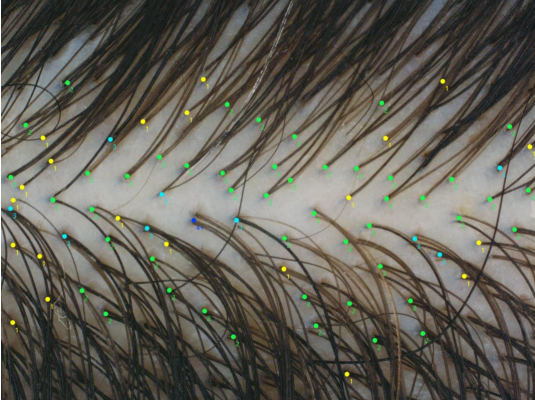
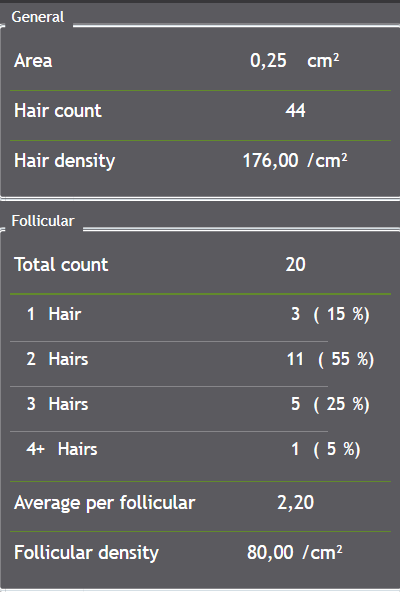
The C-Cube automatically detects follicles visible on the scalp surface. This analysis provides the following measurements:
Total hair count
Hair density per cm²
Average density per zone (N/cm²)
Total count of folicular
Folicular density per cm²
Average hair per folicular
These analyses can help to objectify claims regarding anti-hair loss, thickening, regrowth, and strengthening.
Hair diameter
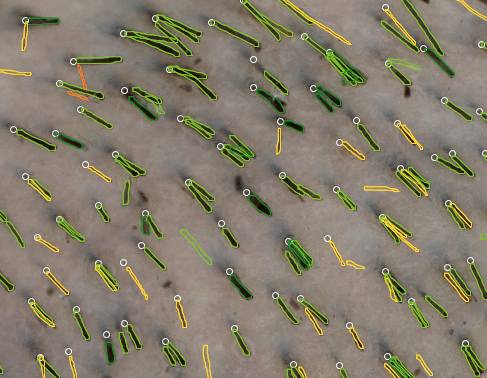
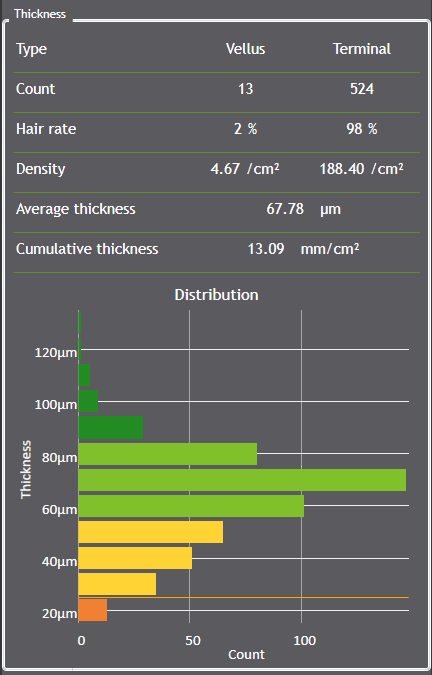
Capillary diameter analysis is based on measuring each fiber detected in the field. This precision allows for complete thickness mapping, with automatic classification of hair into vellus or terminal hair.
Vellus and terminal count
Vellus and terminal rate
Density (Vellus per cm² and terminale per cm²)
Average thickness in µm
Cumulative thickness mm/cm²
Relevant for evaluating the effect of a fortifying, thickening treatment, or one designed to stimulate the conversion of vellus hair to terminal hair.
Hair length
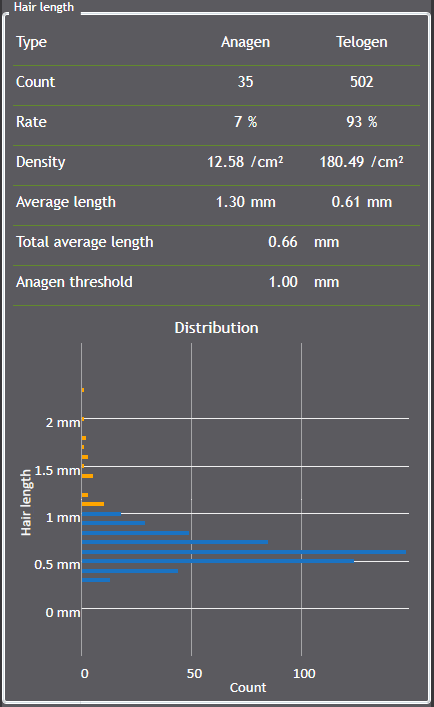
The C-Cube automatically calculates hair length from an image. This analysis is useful in studies on hair regrowth or to compare the condition of hair before and after treatment. The parameters to be studied are as follows:
Anagen and telogen count
Anagen and telogen count
Density (Vellus per cm² and terminal per cm²)
Average thickness in µm
Cumulative thickness mm/cm²
Scalp redness
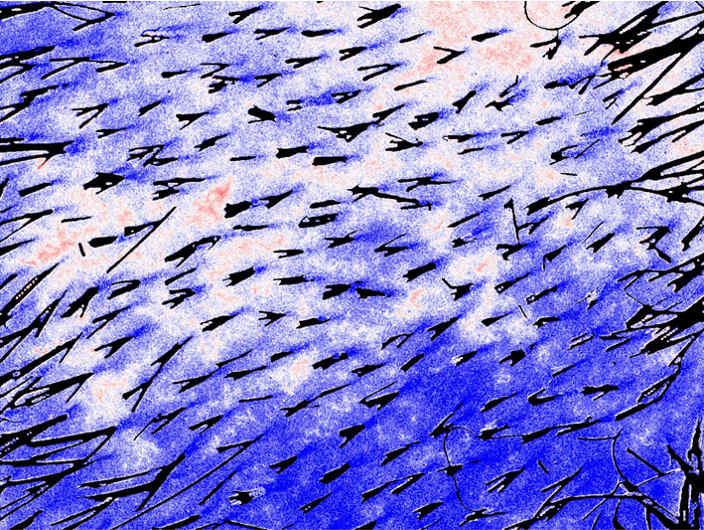
The system is capable of calculating an erythema index on the scalp without interference from hair. The analysis is performed by automatically excluding hairy areas using intelligent segmentation. This analysis is ideal for validating the following claims: “soothes the scalp,” “reduces redness and itching,” or “improves skin comfort.”
Ex-vivo measurements
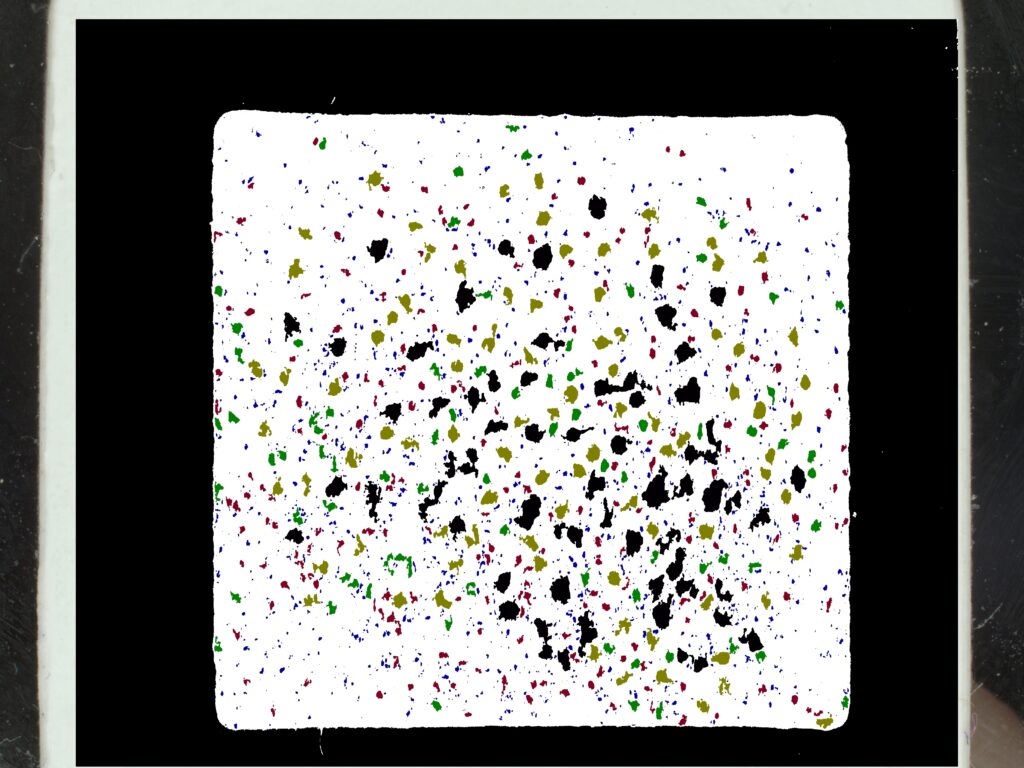
When used in conjunction with a sample reader and Sebutape®, Sebufix®, D-Squame®, or Corneofix® patches, the C-Cube can perform ex vivo analyses.
Sebum
Sebum index %
Classification into 5 categories according to the size of sebum spots
Desquamation
Desquamation index %
Classification into 5 categories based on the thickness of the scales
This data helps to supplement studies on sebum-regulating, anti-dandruff, and scalp-balancing treatments.
C-Cube Clinical Research incorporates artificial intelligence algorithms dedicated to hair analysis. These models, trained on annotated images, automatically detect follicles, segment fibers, and classify hair according to type (vellus, terminal, anagen, telogen). This automation ensures rapid and consistent analysis, while reducing inter-operator variability. However, the system remains under human control: the software allows the operator to check and correct detections when necessary, for example in complex areas or areas with very high capillary density. This hybrid approach, combining AI and expert validation, provides automated and scientifically robust measurements, combining processing speed, traceability, and clinical reliability.
At a time when hair care is becoming increasingly sophisticated, it is essential to have tools that meet scientific and operational requirements. By automating these analyses, the C-Cube saves considerable time while ensuring greater reliability and reproducibility than manual visual assessments. The system thus becomes a valuable strategic tool for validating hair care claims, directly addressing the regulatory and marketing expectations of brands.
The C-Cube, the essential tool for hair and scalp studies.